Thursday, 23 March 2017

Albert Hake and Paul Royle: Australians in the Great Escape.

On 20 March 2017, during the week of the 73rd anniversary of the Great Escape, I presented this talk to the Deakin Combined Probus Club.

Two hundred men tried to escape from Stalag Luft III on the night of the 24th and 25th of March 1944—almost 73 years ago. Seventy-six succeeded in fleeing the German prisoner of war camp. Six were Australian. Only three made it home. Of the 73 who were recaptured, fifty were executed on Hitler’s order. Five of those men were Australian. As we only have a short time, rather than tell you about all of our compatriots who participated in the Great Escape, I will just focus on two escapers: one who survived, and one who was killed in the post-escape reprisals. Through the stories of Paul Royle and Albert Hake, I hope you will gain a sense of the tragedy, the human cost, and lasting impact of that singular event. Firstly, a bit of background about the two men.
Courtesy of the late Paul Royle, via Charles Page. 
Paul Royle was born on 17 January 1914 and experienced a South Perth childhood many would consider idyllic. He lived close to the river, swam whenever he had the chance, and his father built him a little boat when he was about ten which he enjoyed sailing. When he was fourteen, he was selected for a naval cadetship at Jervis Bay on the other side of the country. He stuck it out for three and a half years but, without ready contact with his family, was ‘absolutely devastated by homesickness’ and pulled out.
Jobs weren’t easy to find in the Depression but Paul was unemployed for only a short while. His father, who was travelling around Western Australia inspecting aerodromes, came to his rescue. He needed a driver. It wasn’t the most exciting job but Paul saw a lot of the state and it had another advantage. ‘I was always interested in aeroplanes’, he recalled, and often paid over the two-and-sixpence for joy rides. It was not long before the thought of learning to fly began to appeal so he applied to join the Royal Australian Air Force in September 1934. He was unsuccessful.
The job with his father ended, but he soon found work in the Kalgoorlie gold mines. The lure of aviation was strong, though, and Paul continued to dream of an air force career. War clouds were looming but the young man gave no thought to them. ‘I was not particularly concerned with the political aspects’ of the international situation, he recalled. ‘I wanted to fly’.
With 20 hours as a passenger to his credit and an impressive sporting CV which included rugby, hockey, cricket, boxing, swimming, tennis and lifesaving, as well as some engineering subjects, Paul applied to the Royal Air Force. As 1938 closed, he received the welcome advice that he had been selected and so, the 25-year-old embarked for Britain and flying training in February 1939.
Courtesy of the late Paul Royle, via Charles Page. 
As 1939 progressed, Paul—and almost everyone else in England—expected ‘the worst’. When war was declared on 3 September, the full significance took a while to ‘fully permeate’. He was at least relieved that, ‘at last the suspense is over’. He found that the lack of action during the Phoney War period had a ‘perpetual depressing effect on me.’ He bemoaned the fact that everything ‘seems to have petered out entirely with no air or land activity at all. Wonder when it will start, if ever’. The waiting was getting to him. ‘I can understand why many people take to drink.’ He hoped things would improve when he received a posting to an operational squadron. ‘Even as he regretted the lack of action, he came to appreciate the moral ambiguities of warfare. ‘Gone are the days when [war] was a glorious adventure. Now it is just subterfuge, cunning and murder.’

Courtesy of the late Paul Royle, via Charles Page. 
Paul completed his training on 13 May 1940: he was a fully qualified Blenheim bomber pilot. He had demonstrated high skills during training and was considered one of the most experienced on his course. He was posted to northern France the next day, four days after Germany had launched its mighty Blitzkrieg in Europe. France was under attack and the RAF had come to her aid.

Courtesy of Charles Page. 
On the 18th of May—on his very first operation with 53 Squadron RAF—Paul’s Blenheim was attacked by enemy fighters. He and his two crew members force-landed in a French field. The observer was wounded so Paul and his air gunner carried him to a nearby village and left him in the care of a priest. The air gunner went in search of an ambulance and, although injured, Paul returned to the Blenheim and destroyed it. He hiked back to the village but passed out from his wounds. Later that afternoon, the Germans arrived. The priest had betrayed them and Paul was taken prisoner.
Courtesy of the late Paul Royle, via Charles Page. 
Paul had a brief stint in an army camp where he was officially processed as a prisoner of war and issued with his identification tags. He was then transferred to an air force camp where he notched up much experience in the escape organisation.
Participating in the escape schemes seemed a natural thing to Paul. He’d worked underground at Kalgoorlie so, ‘being in the tunnels was nothing new to me’, he recalled. ‘I felt comfortable—at home digging in the tunnel’. He did acknowledge, however that ‘it was pretty hard work.’ At one point he was even in charge of tunnel operations. Despite the best efforts of the camp’s keen potential escapers, however, Paul recalled ruefully that ‘we did our bit unsuccessfully’.
While Paul and his team dug, the German air force—the Luftwaffe—was building a new state-of-the-art prisoner of war camp located near Sagan in the German province of Lower Silesia. In March 1942, Paul and a large contingent were transferred to the recently completed East Compound of Stalag Luft III, arriving just before Albert Hake.
I'm a bit vague about where I lifted this one from.
 But what of Albert? What had been happening to him while Paul progressed from boy to pilot to prisoner of war? It’s time to backtrack.

Courtesy of the Preen Family.
Albert Hake was born in Sydney on 30 June 1916, almost two-and-a-half years after Paul. He lived near the Parramatta River and, like Paul, enjoyed mucking about on the water. A canoe satisfied his sailing urge for a while but he decided he wanted something much grander so began building a sailboat under the house.
Albert was academically bright and excelled in mathematics, science, metalwork, woodwork and technical drawing. He was awarded a scholarship to Sydney’s Central Technical School where he was assessed as ‘capable and painstaking’. It sounds like he might have been a swot but Albert had a sense of adventure: he was a wannabe mountain climber. His house was built on a rocky outcrop and, while the part facing the street was single-storied, the back part was two stories. He decided it would be much more daring entering his bedroom via the window which was about six metres from the ground. So he drove spokes into the wall at regular intervals and climbed up that way.   
Albert had a sober side as well. He attended church regularly, served as an altar boy, was confirmed an Anglican, and was a member of the Boys Brigade. But the audacious, cheeky side was never too far away. One day, he smuggled a possum into church. Naturally, it escaped from his pocket and caused an uproar.
He gained an apprenticeship with an air conditioning firm, working his way up to draftsman and, during his time off, was a keen ice-skater. One day in early 1940, he met a striking brunette at the local ice skating rink, and was smitten.

Courtesy of the Preen Family.

We don’t know why Albert decided to join the air force, whether it was through a passion for flying, like Paul, or an aversion to the army, fostered through horror stories of trench warfare. Whatever the reason, he turned up at the Woolloomooloo recruiting depot on 8 May 1940 and filled out an application for air crew. He was 24-and-a-half when he was called up on 4 January 1941.

Courtesy of the Preen Family.

He and Noela married on 1 March and, four days later, he was on his way to a training school.
Courtesy of the Preen Family.
We may not know why Albert wanted to join the air force, but we do know that he was a keen pilot. Noela later recalled that, when he obtained his wings, ‘he was so proud of them’.
With hardly any time together during their marriage, Albert embarked for the UK in September 1941. He was rated ‘above average’ and ranked as one of the top three pilots on his operational training course and, on 21 January 1942, he was posted to 72 Squadron RAF, flying Spitfires.
Courtesy of the Preen Family.
Over the next few weeks, Albert carried out convoy patrols, sweeps across France, and escort duties. On 4 April, he took part in a large escort for a bomber squadron which had been tasked with attacking a French railway station. Just south of the target, the Luftwaffe pounced. Albert’s Spitfire was hit by flak which smashed into the propeller. He turned for home but was attacked by five enemy aircraft. He collected a bullet through the leg of his trousers and his engine was set on fire. Despite a crippled aircraft, Albert continued to fight and managed to strike one of the enemy fighters. But his Spitfire was too damaged to cross the Channel homeward. He was forced to bale and landed close to a German troop depot.
Albert was captured almost immediately. After a stint in hospital to recover from burns and shrapnel injuries, he was sent to Stalag Luft III. As a warrant officer, Albert should have been confined to the non-commissioned officers’ compound, but, as his rank insignia had burnt off, the Germans assumed he was an officer because he’d been flying a Spitfire. Albert didn’t disillusion them. And so, he joined Paul Royle in the East Compound.
Courtesy of the Preen Family.
As far as POW camps were concerned, Stalag Luft III wasn’t too bad. It was new, with lots of amenities, but it was still a prison camp and Albert, for one, wasn’t happy at fetching up there.
Lifted from the Imperial War Museum.
 ‘I feel a cad ending up like this darling’, he told Noela. This was a fairly common response. Prisoners of war often felt that they had let the side down by being captured. They somehow blamed themselves. Many agonised about being taken out of the war effort. Some even felt deeply ashamed. They also worried that the folks at home might think they were luxuriating out of harm’s way while others defended and protected country and empire. Indeed, for Albert, it was important to reinforce to Noela in his very first letter home after his capture that he had been fighting right up to the last minute: ‘I got one which evens up my loss.’

Courtesy of the Preen Family.
Despite his shame, Albert realised that, in a way, he was fortunate, given how he had exited from his final aerial battle. ‘That I am alive now is a miracle’, he told Noela. ‘When I think of [the] events which landed me here I have to pinch myself to be sure I am whole.’ Further complicating his already complex thoughts about his captivity, was the fact that, to all intents and purposes, he was safely out of harm’s way and so, he declared to Noela that ‘nothing will stop me from returning to you now’.
Many of the prisoners tried to make light of their circumstances. With tongue firmly in cheek, some referred to Stalag Luft III as ‘Heaven among the Pines’ while others likened it to a holiday camp. In the early days, Albert also presented a rose-coloured portrait of captivity because, he wanted Noela to ‘believe the pleasant pictures of happy POWs which I am assured are portrayed to worried relatives’. He told her of their ‘vegetable gardens, library, educational classes … and sports of all kinds’, and sent photos where he looked happy and healthy with his new friends, if not splendidly attired. 

Courtesy of the Preen Family.
He took up sketching, and studied air conditioning to upgrade or at least maintain his skills, as he and a friend planned to establish their own business after the war. He also formed a band with his roommates and was learning to play a banjo. ‘Don’t be deceived by thinking we make music’, he joked to Noela.
I'm a bit vague about where I lifted this one from.
Paul, too, made the most of his life in captivity. He enjoyed the many shows put on by the compound’s theatre crowd, he played sports, went ice-skating, and studied engineering subjects. He made a great effort to stay mentally active. He recalled that, ‘We spent our time talking, reading in our own language when books arrived, and German newspapers after I had learnt to do so. I translated German news bulletins … and pinned them up on a noticeboard daily.’
Courtesy of Paul Royle, via Charles Page.
So good were his language skills that he even instructed in elementary German. He studied maths and physics, ‘and passed an examination set in England’. As well as wood carving, he turned his hand to making model aircraft. This, and his other activities, ‘slightly alleviated the boredom of camp life … the drabness of our existence’.
Courtesy of Paul Royle, via Charles Page.
But captivity is not an easy state and boredom and drabness are only two of the discomforts. 
I'm a bit vague about where I lifted this from.
Imagine living in an environment where your every movement is overlooked by guards, in such profound intimacy that every breath, every sniff or snort, every tummy grumble, every nightmare, mood swing, and shift on lumpy palliasse was heard by every other man in the overcrowded rooms. Imagine living in those small rooms which had to be kept scrupulously neat so no one could impinge on someone else’s private space. Imaging living where there was no silence or alone time. Just imagine the tension building as men from all walks tried to muddle along with people so different in personality that you probably wouldn’t have bothered knowing them in ‘real life’! Consider trying to be cheery, friendly and tolerant when all you wanted to do was wring the bloody neck of the bloke who spilt the last of the real coffee.
Courtesy of Paul Royle, via Charles Page.  
For some, the intellectual and physical diversions were not enough to compensate for the fact that they were prisoners. Life was going on elsewhere, the war was being won without them, and perhaps there was a sense that they were forgotten. Those who couldn’t adjust to captivity were more likely to suffer from depression or worse: barbed wire psychosis. 

Courtesy of Paul Royle, via Charles Page.
Even Albert, whose first letters home had appeared so upbeat and cheery soon had difficulty recording all the positive things he had been doing in order to cope with his new existence. While he never endured this psychological extreme, he often experienced mood swings, or what he called a ‘fluctuating temperament’.
Courtesy of the Preen family.
Despite the circumstances, Albert was fortunate. He had a lifeline which helped him cope: his strong, continuing connection to home. Noela was a faithful wife, she regularly wrote letters, passed on news from family and friends, and sent comfort parcels to her husband. They were as close as could be, given the circumstances, but with letters taking four months or longer between Australia and Germany—eight months in some cases to receive the response to a query—it was increasingly more difficult to nurture a long distance marriage.
Albert’s frustration at being apart became obvious. He needed something more than just memories of times past and a long-distance relationship with Noela to help him cope with captivity. And so did Paul. As Paul recalled, ‘our major pre-occupation’ and prime factor in coping with captivity, ‘was attempting to escape, over the wire, under it or through it’. And so, both Paul and Albert participated in Stalag Luft III’s escape organisation.
Lifted from Walters, The Real Great Escape.
In April 1943, Paul and Albert left East Compound for the newly opened North Compound. There, a new, audacious plan for two hundred men to escape via a tunnel was put into action. But rather than build one tunnel, they started working on three. The rationale was that, if one was found, there would be another.
Paul was one of those drafted to dispose of the dirt excavated from the tunnels. Nicknamed penguins, because of the way they waddled around with sausages made from towels hidden under their outer clothes, Paul would surreptitiously shake his feet and the soil would fall to the ground, to be kicked or dug in.
Secrecy was paramount. ‘You didn’t want to talk to anybody about anything’, Paul recalled. ‘You all kept your mouth shut because you never knew who was listening.’ And they never knew when any of the Germans’ special security detail would be poking about. Called ferrets by the prisoners, their sole task was to sniff out escape activity, hunt for tunnels, and unearth hidden contraband and escape-related paraphernalia.
Lifted from http://www.dailymail.co.uk/news/article-3058534/Enola-Gay-pilots-flight-logs-Hiroshima-plans-sale.html
Paul became a ‘watcher’ or ‘stooge’, where he kept a look out during tunnelling operations for any sign of the ferrets or goons, as they called the guards. Albert too had an important role in the preparations. He was in charge of compasses, which he meticulously crafted from Bakelite records, slivers of magnetised razor blades, glass from broken windows, and solder gleaned from the seals of tin cans. 

Lifted from Brickhill: The Great Escape.
All were stamped, ‘Made in Stalag Luft III. Patent pending’.
Lifted from Brickhill and Norton: Escape to Danger.
Months of hard work passed. Paul kept watch while others dug and concealed the evidence. Australian John Williams led the carpentry team. Ably assisted by his compatriot, Reg Kierath, they filched bed boards to shore up the tunnels. Tailors fashioned civilian clothes, forgers created false papers. Others stole equipment and manufactured escape kits, all of which contained Albert’s compasses. One tunnel was discovered. Another was decommissioned. As March 1944 advanced, they were almost ready. They just had to set the date but Albert and Paul had already secured tickets to escape.
Courtesy of the Preen family.
Albert needed to write to Noela before he left. The Germans—and the prisoner hierarchy—censored everything so he had to be careful that he didn’t reveal anything that would alert the Germans. He started mundanely enough, thanking Noela for her most recent letters. He’d kept a record of their correspondence and told her that ‘I have everything to date’. As in most of his previous letters, Albert looked to the future he hoped to build with Noela beyond barbed wire. ‘Send me some wool you sweet kid and I’ll help knit those baby clothes.’ Even though the escape would be long in the past by the time she received this letter, Albert couldn’t resist dropping a hint about his intentions. It ‘shouldn’t be much longer darling and I’ll relieve you from the perpetual grind of your daily life. I hope.’
That ‘I hope’ seems to indicate that Albert had a sense of foreboding that something would go wrong, and it’s no wonder. He didn’t have a chance of getting home. For one, rather than being issued with train tickets as part of his escape kit, Albert was what they called a hard-arser—he had to make his way, as best he could, on foot, to neutral Switzerland—700 kilometres away as the crow flies. Of course, Albert could not take a direct route. Once the alert was sounded, there would be a Reich-wide manhunt, forcing him to avoid towns, roadblocks, and roving patrols.
Lifted from Brickhill: The Great Escape.
Even if he could avoid the patrols, how easy would it be to trek cross country to Switzerland? It was still winter. He didn’t have decent footwear. His clothing was totally inadequate. The odds were stacked against him.

With so little chance of success, it’s not surprising that Albert was uneasy. It seems he realised this could be his last letter to Noela and, between the lines—and with the benefit of 20–20 hindsight—we can see his fears that he might not survive the escape attempt. While he usually signed off with a simple declaration such as ‘All my love’, or ‘I love you’, followed by a happy ‘Cheerio’, this time his farewell was more sombre: ‘I love you as always. I hope I can justify your faith in me, dearest, one of these days. Remember me. Albert.’ And three final kisses.
Courtesy of the Preen family.
The date was settled on. The night of the 24th of March was freezing, moonless, and snow covered the ground. The escapers gathered in Hut 104 where the tunnel’s entrance was located, anxiously awaiting their turn to enter the tunnel. ‘All of us were nervous in some way or another. We didn’t want to be caught,’ recalled Paul who, like Albert, was a hard-arser. He was Number 55 to go down the tunnel, and Albert was Number 70.
Lifted from the Australian War Memorial. 
At 8.30 pm, the first escaper was on his way. But the breakout had got off to a bad start. The exit trap door had frozen solid. Then they discovered they’d miscalculated the length of the tunnel so it stopped short of the forest. Each man had to time his dash to the trees to ensure he was not espied by the guards, and that slowed things down. There was an air raid and the power went off, delaying proceedings further. Over-large blanket rolls got stuck as the men trolleyed to the exit. A frame was knocked out, causing a fall of sand which had to be cleared. Another was knocked out, and more sand had to be cleared.
They were way behind schedule when Paul climbed into the tunnel, with just the bare necessities. ‘Everything we had was in our pockets’—a map, one of Albert’s compasses, and some escape supplies. But that was about it. 
Courtesy of the Paul Royle, via Charles Page.
Then, ‘we were pulled on the trolley and that took us from the hut where it started, up to the discharge point. We got to that point [and] climbed up’. It was 2.30 a.m. on 25 March. 
Lifted from Brickhill and Norton: Escape to Danger.
It was very cold when we got out of the tunnel’, Paul recalled, ‘and all we could see was pine trees up above and snow banked up against the trunks … and snow underfoot’. Then, he ‘looked up at the stars, and … back at the watchtower and the barbed wire.’ It was exhilarating; such ‘an achievement’. After almost four years in captivity, the 30-year-old was free. He ran for the pine trees.
Paul’s group headed off. But despite all the months of planning, they hadn’t really thought much beyond the actual breakout. ‘I don’t know what our plan was, except we would head for Switzerland’, Paul recalled. After about an hour trudging through the snow, the party split up and Paul and his partner travelled south. By that stage, Albert was probably struggling his way through the forest as well.
While they tramped, the escape continued but with so many delays, there was no hope that two hundred men would be able to escape. Just before 5.00 am, it was decided that the 87th escaper would be the last. Just as he disappeared down the shaft, a shot was heard. The Germans had discovered the escape. It was bedlam in Hut 104 as the prisoners covered up or destroyed all traces of the enterprise. Guards rampaged through the camp looking for signs of a tunnel. Outside, a manhunt, was initiated. Police, armed forces, Hitler Youth, and thousands of factory and field workers were mobilised to search for the escapers. 
Meanwhile both Paul and Albert were doing their best to head to Switzerland.
Paul and his companion walked as far as they could. At about eight o’clock in the morning, they rested, burrowing into the depths of the pine forest, hiding themselves from view. It was bitterly cold. Twelve hours later, under cover of deep darkness, they resumed their trek south.
Somewhere around 2.30 a.m. on the 26th, they entered a small village and were stopped by three members of the German auxiliary police. ‘We were apprehended’, Paul bluntly recalled. They had been free for just 24 hours and had travelled perhaps 36 kilometres.
Paul and his partner were held locally at first, then, in the morning, they were taken to Sagan and incarcerated in the town’s gaol. Then, with twenty other escapers, he was moved to Gorlitz Gaol. It was ‘an awful place’, he recalled. Crowded, dirty, no blankets, nothing but black bread and watery soup to eat.
I'm a bit vague about where I lifted this from.
No one knows for sure what happened to Albert after he exited the tunnel but it is believed he was captured near Gorlitz, less than 65 kilometres south south-west of Sagan. It seems he had been on the loose for longer than Paul but certainly no more than 72 hours. We do know that his journey through snow and icy water was arduous because he suffered excruciating frostbite. It was so bad he could barely walk when he was escorted to the cell at Gorlitz Gaol where he met up with the other escapers.
Courtesy of the Paul Royle via Charles Page.
The prisoners were interrogated. They were asked if they were married, if they had any children. Some were roughed up and threatened. Some were told that they had been sentenced to death. Paul’s interrogator warned that he could be made to disappear if he did not reveal full details of his involvement in the escape, and would automatically be blamed if any acts of sabotage in the area were discovered. Undeterred, Paul declared to his interrogator that ‘I’m afraid I’ve told you all I can’. The questioner pressed him, but Paul was deliberately vague, claiming only that he was tired of being in prison and had decided to take a chance at freedom.
Each man returned to his cell after questioning. A day or so later, Paul watched as some of his fellow prisoners, including his escape partner, were led away. Albert was also taken from his cell. He was so debilitated by frostbite that those looking out of the window thought that he was being sent to hospital. Paul and the others who remained assumed their other comrades were on their way back to Stalag Luft III. But six of them, including Albert and fellow Australian Tom Leigh, were driven to a wood.

Courtesy of the Preen family.

Courtesy of the Chevalier family.
The prisoners got out of the cars and were lined up next to each other. They were told that ‘the sentence was about to be carried out’. Albert and his fellow escapers showed considerable calm. And then the order to fire was given. A second salvo was delivered, and all the prisoners were dead. Three other Australians were executed in similar scenes: John Williams, Reg Kierath and Jimmy Catanach. They and their fellows—fifty men in total—were cremated.
I'm a bit vague about where I lifted this from.
Courtesy of the Kierath family.
Lifted from Walters: The Real Great Escape.
Meanwhile, Paul was sent back to Stalag Luft III. He was astonished to find that those escapers who had left before him had not returned. When he and his fellow prisoners discovered that fifty had been killed, they were stunned and horrified. No one had anticipated that the escapers would be murdered. They donned black armbands, conducted memorial services and built a memorial, designed by Australian, Wylton Todd.
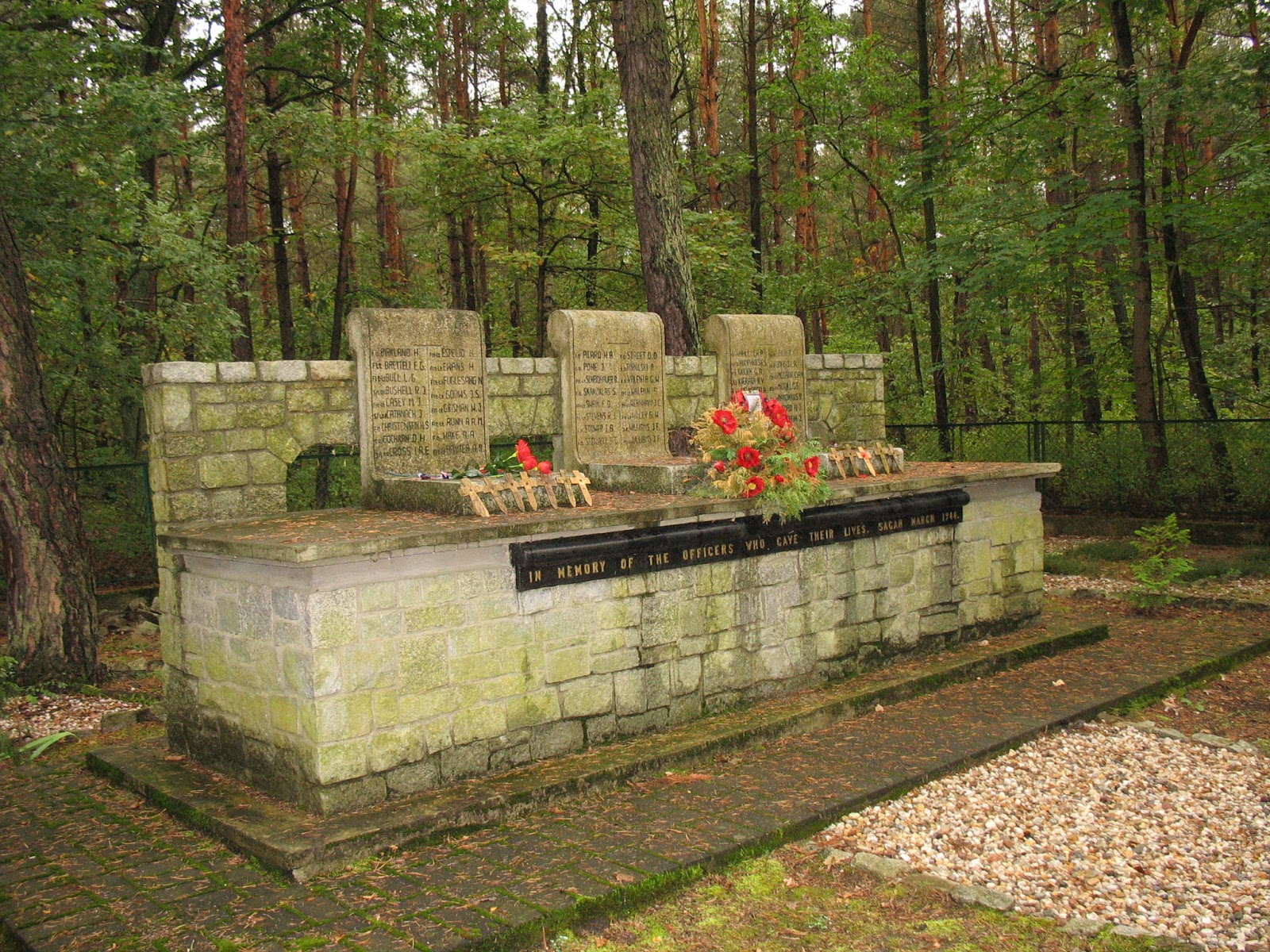
Courtesy of the Preen family.
Later, when the prisoners tried to rationalise the mass escape attempt, many claimed that, although there was little possibility of success, it was their duty to try. Moreover, they believed a large-scale breakout would divert a good proportion of German resources into recapturing them. Albert’s motivation, however, clearly focused on Noela: ‘Well, dammit all, I’ll be home for our next anniversary, darling’, he declared. Neither duty, diversion nor even love played a part in Pauls rationale. In a brave, late-life honesty that is contrary to the accepted narrative, he admitted that the idea was simply not in my mind. No  thought of it. We only thought of ourselves getting out.

 
I'm a bit vague about where I lifted this from.
As for the consequences, the murder of fifty of his comrades, including his escape partner and Albert Hake, Paul was pragmatic. ‘You couldn’t foresee these things, you just wanted to get out, then what happens would happen.’ Even so, Paul, like the other survivors, had to live with the ‘what happens would happen’ and, even at the end of a long, full life, he still hadn’t ‘a clue as to why I wasn’t chosen’; why he had survived when others had been murdered.
Paul remembered few details of his captivity after the Great Escape. Those events overshadowed everything else. He was eventually liberated and began a new life beyond captivity. He wanted to fly but there was no place for him in the post-war air force. Even so, his star shone professionally with a good career in mining and engineering which took him around the world. It was a different matter, however, on the home front. He married quickly after the war but that relationship did not work out. True conjugal bliss of over half a century’s standing came only after his 1961 wedding to his second wife. He admitted few long term consequences of captivity but he was reticent about his experiences for four decades and, when he started talking about it, he only gave scant details. The deep emotion of those events can only be read between the lines, and in the long pauses of his recorded interviews. It seems he bore the guilt of survival until the very end of his long life.
Courtesy of  Paul Royle, via Charles Page.
Paul died on 23 August 2015. He was 101. Despite his career success, publicly, at least, it seems as if the events preceding his 24 hours of freedom seventy-one years earlier had defined his life. But they did not. ‘That was a minor part of my life, only a matter of a couple of days’, he stressed.
And what of the consequences of Albert Hake’s part in the Great Escape?
Courtesy of the Preen family.
At the most basic level, Noela, of course, lost her husband. They may have spent most of their brief marriage apart, but he was dearly loved, and sadly missed. And that was the inscription she placed on his memorial headstone.
Courtesy of the Preen family.
But the ramifications were more profound.
As he was sailing away to England, Albert wrote to his friend Ray Preen who eventually married Noela’s sister and announced ‘I’m going to place you under a few obligations’. He told Ray bluntly that, ‘If I don’t come back, I want Noel[a] to marry again’. He didn’t want Ray to find her a husband, he just wanted his friend to quietly make her understand that it ‘was my wish’. 
Courtesy of the Preen family.
He recognised that Noela ‘is still young and a type that should be married’. He believed that, ‘for such a girl to live out her life unmarried, would be a crime’. But Noela did not marry again. Instead, as Albert had begged in his final letter to her, she remembered. She put in memoriam notices in the paper, year after year, as did other members of his family. 

Courtesy of the Preen family.
She relived the handful of days they had spent together. She recalled their future plans but they never had the children they wanted. She treasured Albert’s personal effects, returned after the war. She kept safe the certificate which stated that Albert had been mentioned in despatches for distinguished service. 

Courtesy of the Preen family.
She read and reread her husband’s letters, just as he had done with hers, while he was in Stalag Luft III. She cherished the knowledge that Albert’s fellow prisoners regarded him as ‘one of nature’s gentlemen’.

Courtesy of Geoff Swallow.
Fifty deaths was a tragic outcome of the Great Escape. But so too was the effect on those who were left behind. Those, like Paul Royle, who suffered survivor’s guilt. The fatherless children. The children who were never born. The widows. Those who never lived the life they’d planned. Those who remembered. Like Noela.
Lifted from Brickhill and Norton: Escape to Danger.

Thursday, 16 March 2017

Review: 'Stalag Luft III. An Official History of the "Great Escape" POW Camp'

Given my current research I have been avidly awaiting my copy of Stalag Luft III. An Official History of the 'Great Escape' POW Camp, the history of the British and Commonwealth compounds at Stalag Luft III. 

I must admit that I was disappointed in that, although there is preface, there is no proper introduction setting the whole thing in context and explaining something of the background to the production of the report which you come to expect with the general release of  war time reports. Seb Cox's editorial introduction to the official Battle of Britain report in the RAF Official Histories series published by Cass, and Graham Pitchfork's introduction to the Air Ministry's escape report, published by The National Archives, come to mind. Both attribute the original authors and include significant background detail which adds to an understanding of the report. 


The nominal index is helpful, especially when tracking someone through multiple camps, but if mistakes were made in the original (sorry, life is too short to check), no attempt to correct them was made here. For instance, Gordon, JAR is actually JAC (James Anthony Cathcart) and F/Lt Hake AA was actually Warrant Officer Albert Horace Hake. There is no excuse for getting the latter wrong in this publication as he was one of the Fifty killed so has a certain amount of public recognition. And did the original report spell Belaria incorrectly?  


(Courtesy of the Preen Family)  

In my opinion, a subject index, including names, would have been better, and professional indexers do provide this service. Or am I the only one who wants to easily find compasses, or radios, or code work, for instance, without trawling through individual pages and so this expensive type of index was considered unnecessary? 

It is certainly useful having the reports of all the camps together: I made the mistake of paying a fortune for the North and East Compound reports only, and could never quite afford to get the Centre and Belaria compound's reports. Having all the British compounds in one handy little book is very helpful. 

One final niggle: there was much more to Stalag Luft III than the Great Escape, as is clear from the report itself. Why do the publisher's feel they need to hang the book on that event in its subtitle? (Rhetorical question: I know that the Great Escape is the camp's most recognisable event and accordingly the most marketable, but really, it annoys me because that experience was not shared by the majority of SLIII's prisoners.)

There is no author or editor attribution. I don't think it is available in Australia yet. One friend I know purchased his copy from Amazon, and mine came via The Book Depository (postage free). If you haven't forked out for the original which is at the UK archives, it is worth having. It is useful and informative, but with such a little effort and the assistance of an editor with knowledge of the subject to note errors in the original and interpolate clarifying footnotes and corrections, and a more detailed index, it could have been so much better. 

Wednesday, 8 March 2017

A woman's response to captivity

A little musing given today is International Women's Day. More often than not, the impact of war on women is forgotten or airbrushed out of the usual sort of military book. My aviation biographies have both included details of the women my subjects loved but word limit precluded only brief mentions. I had more scope in 'Australia's Few' to deal with the impact of loss on the airmen's wives, girlfriends and mothers. Strange as it may seem, women will have a more significant place in my POW thesis because I believe that captivity (and war in general for that matter) was not just a male experience. It was also a female one. And so, (at this stage) roughly a third of my thesis is dedicated to women's responses to their menfolk's captivity; the importance of the women to the POWs as links to home; and the significance of their absence in the men's lives behind barbed wire.

When I first started research I was worried that I would not be able to gather evidence to tell the women's stories and, to be truthful, two families declined to provide me with access to their letters because they believed they were too private. I do understand this attitude but as well as protecting privacy, they are also ensuring that women's responses to captivity continue to be airbrushed from history.

Fortunately, other families have been more supportive of my desire to recount the female perspective. Here is a small indication of the pain Mrs May Fraser felt when she heard her son Donald was missing. She did not know if he was alive or dead, and it was the second time he had gone missing on operations so she knew it would be some time before she heard anything definite. If at all. She wrote to a friend who used to serve with him, hoping for just a little bit of hope to cling on to.

I am writing to ask you if you can give us any idea of the work Don was doing at the time he was reported missing, where you think he would likely be, over the land, or over the sea—is it possible he would be Tunisia, or do you think Italy or Sicily would be more likely spots, and will you honestly tell me, what you think of his chances of still being alive—I try to hope that he may be a POW and if he came down over the land there may be a chance that he is—but I am very afraid of the sea. I know they have rubber boats and every other contrivance for safety, but if they are shot down, would they have time to use them. That is what is worrying me so, it just goes on and on in my head, and makes me fear very much, that I will not see my son again.

The friend wrote back, and she gladly accepted the gleam of hope he offered but she still suffered from the lack of knowledge. 'I haven't been well, the worry and anxiety always sends my blood pressure.' She eventually heard that Donald had been captured and sent to a prisoner of war camp. Her granddaughter recalled that her relief that he was safely out of harm’s way in a Stalag Luft III was intense. There was a great sense of peace that he was safe. And then May waited for his return.


Tuesday, 14 February 2017

Name, rank and service number. POW interrogation in Dulag Luft.

I’ve been looking at what the Australians of Stalag Luft III went through during interrogation, and how they responded. Not everyone had a bad time of it, but a good many did, and here are the recollections of just a few.
The Luftwaffe took over the Army’s Offiziersdurchgangslager (officers’ through camp) at Oberursel in December 1939 and renamed it Durchgangslager der Luftwaffe (through camp of the Air Force). Located just northwest of Frankfurt, one part of the complex served as the Luftwaffe’s main transit camp and the other became the Luftwaffe’s main intelligence gathering centre. The intelligence and transit sections were separated in September 1943; the intelligence staff remained at Oberursel but the transit camp was relocated to Frankfurt, near the railway station. That was destroyed in a raid in March 1944 and a camp was constructed at Wetzlar, about 30 miles north of Frankfurt. Interrogations continued to be carried out at Oberursel. The entire facility soon became known simply as Dulag Luft and, despite a number of name changes over the years, and regardless of location, continued to be referred to as Dulag Luft.
Germany’s attitude to interrogation was organised. Within weeks of the beginning of the war, the Germans recognised that prisoners of war would be good sources of information about British morale, war-readiness, and military strength and matériel. Army prisoners, however, were usually taken in large groups either by battle winners, or as a consequence of surrender. Any interrogation was usually carried out close to the battlefield and was at best cursory. Assiduous and wide-ranging intelligence gathering and assessment became the province of the Luftwaffe which recognised that aircrew would be great assets in the intelligence war. Accordingly, a dedicated and ‘sophisticated sifting centre’ was co-located with the Dulag Luft transit camp and all aircrew captured in German held territory passed through it before transferring to permanent camps.
Dulag Luft evolved into a professionally-run organisation where intelligence gathering was developed to a fine art. By intensively interrogating new arrivals, scrutinising documents and equipment carried by the airmen, and examining crashed aircraft, interrogators developed a detailed knowledge of allied air operations. It was acknowledged as the most efficient interrogation facility of the war and boasted an extensive archive which included press clippings, photographs, maps, and squadron histories, and comprehensive lists of squadron personnel. More than one man was shocked by the level of detail accumulated by the interrogators.
*****
The period immediately after capture is acknowledged as one of the most physical and trying phases of the entire captivity continuum. Formal interrogation, which occurred within days of apprehension was, for many, the worst experience since their last battle. Recognising that prisoners still suffering the shock of captivity would more easily succumb to the pressure of interrogation, new captives were whisked to preliminary detention for questioning by local military personnel before they were almost as quickly ferried to Frankfurt. Some were humiliated by the local populace en route. Some had made abortive escape attempts while in transit and their confidence was at a low ebb. Once they arrived at Dulag Luft, every aspect of their confinement in the cooler—the prisoner name for detention cells both at Dulag Luft and permanent camps—was designed to create psychological pressure, thus breaking down any resistance to interrogation.
The Dulag Luft interrogators spoke perfect English and were professional. They developed sophisticated, insidious interrogation techniques which included ‘softening up’, repetitive questioning, wheedling details bit by bit, and alternately adopting friendly and menacing styles. They also deployed food and sensory deprivation, varying degrees of torture, and took advantage of continuing shock.
Rooms were kept in darkness for extended periods and the walls were so thick the airmen could not orientate themselves to the outside world. Before they were consigned to solitary confinement in a small cell with few amenities, new arrivals were stripped of their belts, boots and uniform, underwent a complete—and in Ronald ‘Ronnie’ Baines’ recollection, ‘embarrassing’—body search and were x-rayed. While some items were returned, Article 5 of the Geneva Convention stated that ‘identity tokens, badges of rank, decorations and articles of value may not be taken from prisoners’. Personal items (other than weapons) were eventually returned. Uniforms, however, were not. In Norman ‘Bill’ Amos’ case, he was issued with an ill-fitting pair of riding pants and a woolly singlet and a pair of wooden clogs.

Ronald Baines

Norman Bill Amos
There were many significant examples of inhumane treatment at Dulag Luft including isolation, discomfort, physical and sensory deprivation and varying degrees of torture. Indeed, according to one commandant, ‘no amount of solitary confinement, privation and psychological blackmail was considered excessive’. It was a disturbing time and Richard ‘Dick’ Winn, for one, alternated between despondency and near panic and hope. ‘These mood swings were very frequent.’ Compounding their distress, the airmen were placed on harsh rations. It did not appear to matter that such treatment contravened the Geneva Convention.
Richard Dick’ Winn
In his diary, George Archer recorded the three days he spent in the Dulag Luft cells. He briefly noted the conditions of his accommodation and treatment. ‘In cooler. Bloody awful. Nothing to do but sleep.’ The next day, he was ‘still in cooler, very hot. No windows open. No books or shaving. Sleeping is the only saviour. Five dirty spuds and soup for dinner. Bread and herb tea. B. and tea.’
George Archer. Courtesy of David Archer
Archer’s contemporary diary, jotted into a small pocket notebook, had little space for elaboration. Those compiling late-life accounts had more scope, and decades’ reflection to record the more challenging physical and psychological aspects of this phase of captivity. ‘The room in which I was placed was unlit, virtually soundproof, overheated and hence enervating’, reminisced Alex Arnel. Bruce Lumsden, Bill Amos and Dick Winn recalled alternating hot and cold in the cells where any sleep was intermittent. Kenneth Gaulton sweltered ‘with all the heat turned up in the middle of summer; it was pretty uncomfortable’, and Ken Todd included in his wartime log book a pencil drawing of his cell annotated ‘heaters on in summer, off in winter’. Lumsden began to realise that this contravention of the Geneva Convention was ‘another part of the game of prisoner harassment’. Knowing this did nothing to alleviate Lumsden’s ‘sense of mingled rage and humiliation’.
Alex Arnel. Courtesy of Alec Arnel
Bruce Lumsden
Kenneth Gaulton 
 http://australiansatwarfilmarchive.unsw.edu.au/archive/1276-kenneth-gaulton
Ken Todds cell. Courtesy of Peter Todd
Once in the interrogation cell, polite, seemingly friendly and courteous questioners tried to coerce with cigarettes, bonhomie and, in the case of Alex Arnel, morning tea of scones, honey and coffee and admiration of the Spitfire. Alex Kerr, who had come to Dulag Luft after many months in hospital, recalled that he too had received ‘soft treatment’, possibly because, he speculated, any information he might have would be out of date. When the soft touch, deployed by ‘gushingly polite’ interrogators failed, the Germans again contravened the Geneva Convention.
Alex Kerr
 http://australiansatwarfilmarchive.unsw.edu.au/archive/1489-alexander-kerr
Arnel was threatened with being handed over to townsfolk who had been subjected to propaganda about the allied terrorfliegers (terror flyers) who had subjected them to frequent bombing raids. ‘What do you think would happen?’, the interrogator demanded of Arnel. When that failed to elicit a response, Arnel heard his neighbour being removed from his cell, then shouts and a volley of rifle fire. ‘I tried to convince myself that this was just another psychological pressure to get us to “cooperate” but nagging doubts remained.’ Douglas McLeod was deliberately lied to in order to weaken his defence. He was told that ‘3 members of my crew had been killed’. As a Jew, Cy Borsht suffered physical as well as psychological assaults. His interrogator hit him on the back of the head, lightly at first and then harder and harder. Finally, in the face of Borsht’s continued resistance to questioning, he ‘played the Jew card with me’, threatening to hand him over to the Gestapo. ‘The information he was after was not important, really. He was making an issue of it’, Borsht recalled 71 years later. ‘He was making a big fella of himself.’

Cyril Borsht

Douglas McLeod
Kenneth Gaulton later claimed that the only time he was deliberately tortured was during his encounter with the interrogators. Doug Hutchinson was also tortured. Although he was admitted to nearby Hohemark clinic for shrapnel wounds to elbow, legs and body, and a piece shot from his left foot, he was denied treatment for three weeks. He was on his back during interrogation. ‘I couldn’t move very much, I had a leg that was aching like hell. … I had bits and pieces off all over me, and I was starting to feel sore. And I suppose there was a certain reaction catching up with me, from the crash.’ Despite pain and discomforted, Hutchinson he resisted questioning. His interrogator then aggravated his foot wound. While Charles Lark, who had been seriously injured during his last operation and had had an eye removed before being transported to Dulag Luft, did not mention deliberate torture, he requested medical attention on a number of occasions and was refused.

Douglas Hutchinson. Courtesy of Robert Douglas Hutchinson

Charles Lark
Despite the physical and psychological assaults many found opportunities to withstand ill-treatment. Some had been briefed during escape and evasion lectures about what might happen during interrogation, or had viewed the 1940 training film, Enemy Interrogation of Prisoners. They had been warned that the Germans would consider them valuable sources of information and would question them; they were primed to be wary of tricky interrogation techniques. The airmen had also been alerted to the possibility of stool pigeons. As well as formal briefings, the rumour mill worked overtime and many ‘heard’ that they might be beaten and tortured to extract vital military ‘gen’ (information).
Armed with this knowledge and rumour-based expectation, the airmen took control to mitigate the worst of the debilitating effects of sensory deprivation. They actively exerted personal power to raise their morale and maintain self-discipline. Bill Amos played with a piece of string to amuse himself and to keep himself alert during solitary confinement. Dick Winn—who spent his 22nd birthday in Dulag Luft—did physical exercises and composed rhyming poetry in his head. ‘I figured that I should do the thing that was most difficult and time consuming for me. Each verse took many hours and sometimes days.’ Winn also indulged in some self-serving sabotage. Rather than put up with the ‘unbearably hot’ room, he disconnected one of the heater’s electrical wires  with his ‘dog tag’, now returned to him, and manipulated his fountain pen barrel to turn the heater on and off.
In physically alleviating the worst effects of the heat torture by rubbing his handkerchief on the early morning condensation in his cell, and urinating into his handkerchief and using the moisture to ‘just wet the lips’, Kenneth Gaulton also waged a psychological defence against his circumstances. ‘That was the way I beat the system in my mind’. Alex Arnel had received little briefing about what might happen in interrogation but he had already been subjected to German techniques in a local holding cell shortly after he was captured. Drawing on that experience, he battled disorientation, depression and boredom. He counted the straws in his palliasse, sang hymns and songs loudly and recited all the poetry and scripture he could remember. Bruce Lumsden turned to his religious background as well. ‘I sought comfort and strength in prayer and in softly singing a hymn—the 23rd Psalm.’
Once the interrogation began, Justin O’Byrne was alert to German ploys for information. After about seven or eight hours alone in the cell, ‘a German “leutnant”’ came into his room and offered him an English cigarette. ‘He gave me a form with a big Red Cross on the top and asked me to fill it in’. O’Byrne and Bill Amos had been warned that these forms were bogus, designed to extract military details. Charles Lark believed very few were taken in and Tom Wood, for one, recognised immediately that ‘of course it was a fake’. O’Byrne certainly ‘had no intentions of falling for such a simple ruse’. Accordingly, he only ‘gave them my name rank and number which is compulsory under International Law’. The ‘leutnant’ asked O’Byrne why he ‘had not filled in the particulars concerning my squadron, group, duty, etc.’ and ‘said it was for the International Red Cross in Switzerland and that unless I completed it my next-of-kin would not be advised of the fact that I was still alive’. O’Byrne continued to refuse to complete the form so his interrogator said he would come back the next day ‘to see if I felt in a better mood to fill in the form’.
Justin OByrne. Courtesy of Anne OByrne
Each airman had a clear duty to protect the RAF’s security; he was still considered on ‘active service’ and was obliged to safeguard service information at all times. Indeed, that ‘responsibility is greatest after capture’. The training film Enemy Interrogation of Prisoners reinforced the onus of air force discipline and continuing service despite their captivity status:
You should remember that, although a prisoner of war, you are still at British subject and under the orders of the Royal Air Force. Obedience to these orders and procedure means that, far from being of no further service to your country, on the contrary, you can continue to be of great service to your country and comrades.
Dodging questions and refusing to complete forms was not just a source of pride for O’Byrne. He recognised he was still subject to air force discipline. And so, ‘I evaded every leading question he made’. It was also an opportunity to get the upper hand. ‘Whenever there was a lull in the conversation I enlarged on the advantages of using ‘De boric’, the boracic-glycerine treatment for blowfly strike on sheep’! After about two hours of question and evasion, the ‘leutnant’ threatened O’Byrne that ‘I would never see any of my friends and relations again if I did not give him the information he wanted’. O’Byrne continued to resist. ‘I told him that was just too bad, and he stormed out and slammed the door.’
Even through torture, Doug Hutchinson also attempted to outwit his questioner. When silence didn’t work, ‘I tried to be smarter all the time’. When they asked something, he would reply, ‘“You know the answer. Why are you asking me?” That sort of thing. And they thought we had radar on the aircraft, which we didn’t, and they believed that, so I said, “Well, you know, so why are you asking me about it?”.’ Cy Borsht also managed to act smarter during the continuing physical and psychological abuse—‘it was just simply a matter of repeating what you’ve already told him’—until, at the end of ‘a harrowing four days’ he was released to the transit camp.
After interrogation, the prisoners were taken to Dulag Luft’s transit camp to join the other prisoners. ‘What a relief it was to mix with our own crowd again!’, recalled Charles Lark. Henry Harry Train was pleased to be reunited with his crew members, including one who he thought had been killed during the attack on their aircraft. Reuniting with old friend was morale-raising but so too was being able to share their recent experiences and identifying with those who had overcome adversity. ‘There are some original characters here and spirits are always high’, Train recorded. ‘Pretty well every one of these boys have looked death in the face … and their stories are well worth listening to’.
Henry Harry Train. Courtesy of Peter Mayo
The horrors of final combat, the shock of captivity, and any lingering effects of ill-treatment were put aside by many in Dulag Luft’s transit camp in the face of like-mindedness, shared experience, conviviality, ‘wizard’ food provided courtesy of the Red Cross, and an energetic social life which included sport, films, concerts, and a steady stream of new arrivals. Within a few weeks, the prisoners were transported to a permanent facility. Officers travelled ‘by 3rd class’ train, ‘sergeants by cattle truck’. Regardless of the mode, it was, as far as George Archer and Ronnie Baines were concerned, ‘bloody awful’.
When I went through their accounts, I found that some prisoners mentioned they had had no briefing, others mentioned they had seen a training film about the experiences of a bomber crew after they’d been taken to Dulag Luft. I let my fingers do the walking and found Enemy Interrogation of Prisoners  on Youtube. I thought you might be interested to see what the RAF thought would happen. Reality, for many as you have seen, was quite a bit different.
The film lasts about half an hour. If you don’t have time to watch it, here is the precis courtesy of the Imperial War Museum:

Film consists of a fictional episode with actors and spoken dialogue. Brief film sequence shows a Lockheed Hudson taking off. Film begins with an actor portraying a senior RAF officer who introduces the characters and sets the scene. Before the mission aircrews turn out their pockets to remove identifying articles. A plane is forced to land in enemy territory and the crew taken prisoner; the film then describes how German intelligence learn of a new airfield and proposed bombing raid, starting with a simple clue—a bus ticket which reveals the home station of the prisoners—and subsequently building on this by the use of a variety of techniques— separation of the crew, fraternisation, ‘hard/soft’ interrogation and leading questions, a German posing as an RAF officer, and listening in on ‘idle chatter’ between crew members. Germans then launch a pre-emptive raid which destroys British aircraft and postpones planned raid. Conclusion—give only your name, rank and number, and ‘keep your mouth shut’. http://www.iwm.org.uk/collections/item/object/1060013719

Friday, 27 January 2017

Hell, haven or heaven? Reactions to Stalag Luft III.

I am always interested in how people cope with a difficult situation, and especially how they make the most of it. Take, for instance, the reactions of the men of Stalag Luft III to their new environment.
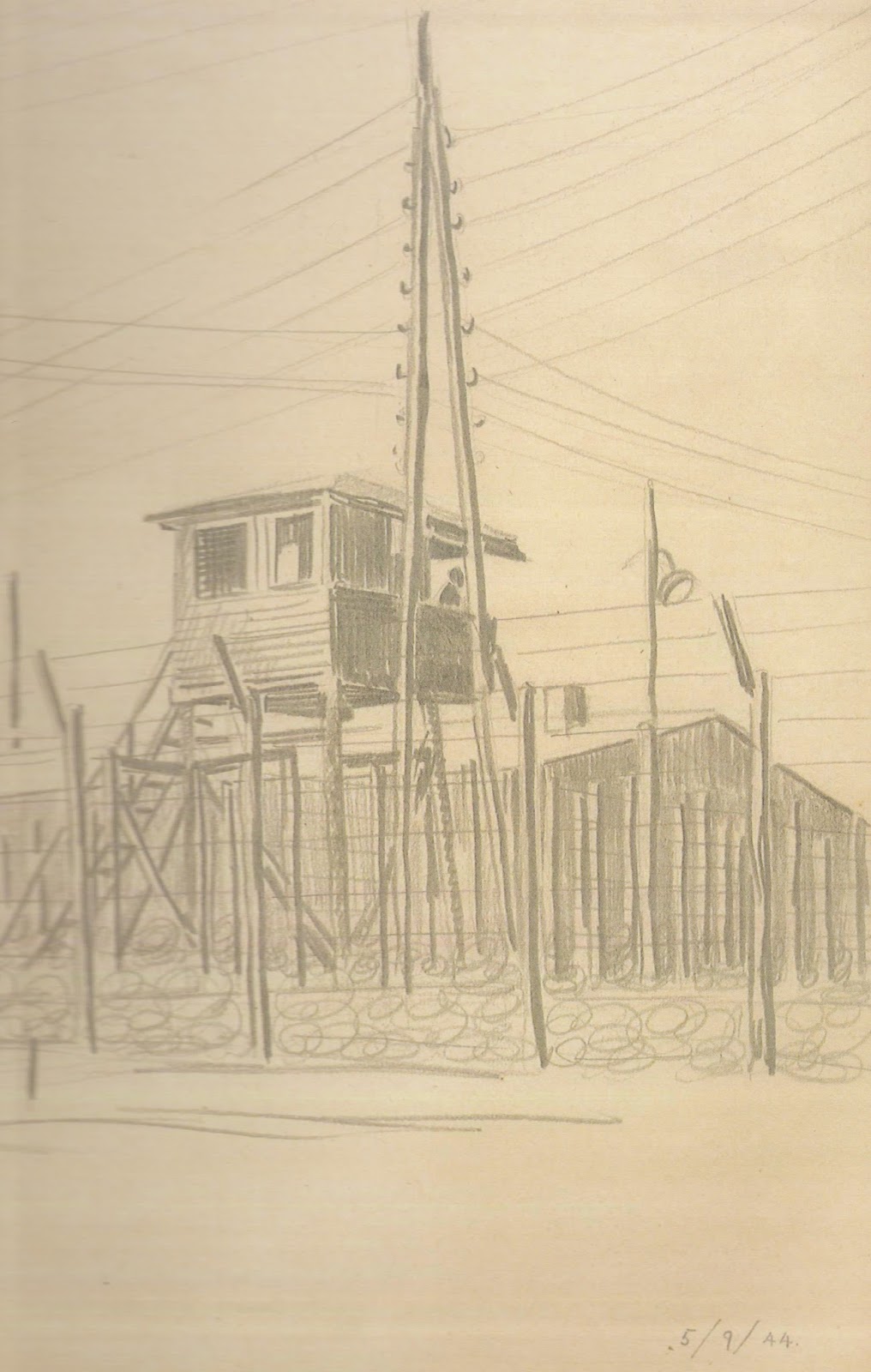
Stalag Luft III, in 1945, sketched by James R Taylor. Jim Taylor, a Scot, had given the original of this pencil drawing to Ken Carson. Courtesy of John Carson.
Each compound was ringed by two barbed wire fences, 10 feet high, whose tops sloped inwards, making climbing difficult. The 6 feet gap between—the Löwengang, or Lions Walk—was filled with thick coils of barbed wire, about 3 feet high. (The Vorlarger was also enclosed by a barbed wire fence.) Thirty or so feet from the inside barbed wire fence, 18 inches from the ground, was a warning line ‘beyond which’, Justin O’Byrne recalled, ‘it was suicide to step’. But not immediately. Prisoners were forbidden to cross it but, if they did, they were given two alerts, after which the guards were ordered to shoot. With so much barbed wire about, O’Byrne, looking back on his wartime accommodation, likened it to ‘the usual type of German concentration camp’.
Justin O'Byrne prior to his arrival at Stalag Luft III. Courtesy of Anne O'Byrne.
 While those of Stalag Luft III’s complement with experience in Buchenwald Concentration camp would perhaps disagree, the barbed wire certainly did nothing for some prisoners’ well-being. As one man put it, ‘It is really a horrible prospect looking out on a world through barbed wire: it gives you the feeling of having absolutely nothing to do with it’. Others, however, took a different view.
One man told his correspondent that ‘if it were not for the barbed wire and sentry boxes one could almost visualise a huge holiday camp’. Rather than gazing at his new abode through rose-tinted glasses, this chap appears to have sanitised his account for the benefit of the homefolks. He was not the only one to liken Stalag Luft III to holiday accommodation. Peter Kingsford-Smith took up the theme in his wartime log book. His drawing of the tree and barbed wire bordered compound, with guard tower to the left and wooden hut to the right, took the guise of a naïve travel poster captioned ‘furnish flats at mod[erate] rates. Holidays-at-Sagan’. Promoting ‘summer & winter sports’ interested holiday makers were to apply to ‘Luftwaffe headquarters’ or Stalag Luft 3’. Arthur Schrock, also painted a mock travel poster, complete with pines, snow and barbed wire, in his wartime log book entreating tourists to ‘Visit Sagan. A Haven of Tranquility [sic] Midst the Pines of Nieder Schlesien [Lower Silesia]’. 

Courtesy of Andrew RB Simpson.

Bill Fordyce depicted the ‘horrid result of life of debauchery & drunken-ness at the “haven-in-the-pines” Stalag Luft 3’.

Courtesy of Lily Fordyce.
 John Cordwell, much taken with the coniferous tree-scape, captioned his depiction of North Compound and its needle-y border ‘Heaven in the Pines!’; it was one of the few artefacts Kenneth ‘Ken’ Carson brought out of the camp.

Ken Carson's copy of John Cordwell's map of North Compound. Courtesy of John Carson.
British-born Archibald Sulston’s watercolour of a pine forest-backed hut in Peter Kingsford-Smith’s wartime log book is also entitled ‘Heaven in the Pines!’ but his tongue, like the tongues of the other artist-commentators, was firmly planted in cheek given the presence of an overflowing waste container, large puddles of water, an unsteadily-leaning wooden cask and a number of tree stumps in the drawing’s foreground. (It seems as if this was a common theme for Sulston because he painted a similar image in his own log book.)
Archibald Sulton's rendition in his own log book. Lifted, with thanks, from http://www.dailymail.co.uk/news/article-3058534/Enola-Gay-pilots-flight-logs-Hiroshima-plans-sale.html.
For some, there was no humour in the depiction of the camp as haven or heaven. Jock Bryce thought one of the Red Cross magazines erred ‘on the bright side when it described Luft III as “the heaven in the pines”’. John Osborne may have ‘almost settled down’ after his recent arrival, but was quick to tell his family that ‘it’s no heaven’. Osborne also resented the rosy portrayal of the camp by the Red Cross who frequently reprinted extracts from letters, such as the barbed-wire holiday camp mentioned above, depicting the brighter side of life. ‘What tales do the Red Cross print of our conditions?’ Albert Hake, however, was more than content with the images of ‘the pleasant pictures of happy POWs which I am assured are portrayed to worried relatives’ by the Red Cross and Prisoners of War Relatives’ Association. It gave him comfort knowing that his wife Noela was taken in by them. 
At least one man categorically believed that Stalag Luft III was both haven and as close to paradise as you could get in a prisoner of war camp. ‘After two months of hell of earth’ at Buchenwald Concentration Camp, where every hair on Keith Mill’s body had been shaved off, and he and his fellow prisoners, including eight other Australian airmen had ‘slept with rocks for our beds and the sky for our blanket for three weeks’ before managing ‘at last to get into a hut about 50 yards long with 700 people in it’ where they saw people die there, ‘some in strange ways’, Stalag Luft III ‘was heaven’.
Keith Mills and his wife, Val, in 2004. Lifted, with thanks, from http://www.dailymercury.com.au/news/true-gentleman-bows-out/1280342/ (Read this touching obituary.) 


Wednesday, 11 January 2017

Cornflowers in Belaria

The simplest things can evoke a memory.
Today I worked on 'setting the scene' for the men of Stalag Luft III: the history of camp, why the site was selected and the particular features that made it attractive to both the Germans and potential escapers. I also looked at how the men responded to the camp when they first saw it. Most waxed lyrical about the forest and the louring pine trees, or spoke about the sandy soil. Some mentioned the dust or mud, depending on the season, and all of course talked about the weather.
Doug Hutchinson, however, noticed something different. He was writing just after the invasion, and was hopeful that he would not be a prisoner for too much longer.
Doug Hutchinson. Courtesy of the Hutchinson Family Archive.
He had also recently 'celebrated' his fifth wedding anniversary, and the fourth he had spent away from home.
Doug and Lola Hutchinson on their wedding day. Courtesy of the Hutchinson Family Archive.
He was still very much in love with his wife, Lola, and missed her terribly. I'm not surprised his eyes took in something more than just the dust and trees:
'This morning I gathered a large bunch of blue cornflowers from around the [Belaria] compound. They are the national flower of Germany and grow wild all over the countryside. Somehow, when I see beautiful flowers, I always connect them with you, my dear. Two beautiful things together. Do you remember how happy you were when picking flowers from our garden, and how you delighted in giving large bunches of them to your friends? Those days will come again, but till then all I have are the memories.'

Cornflowers in Germany. Nicked, with gratitude, from http://nationalflowers.info/2011/01/31/the-state-flower-germany-knapweed-cornflower/
The memory of Lola was so important to Doug that, on the forced march from Stalag Luft III, where space in knapsacks and on makeshift sledges was at a premium, he tucked in all the letters she had written to him during the almost two years of his captivity.